![NPO法人 Forum2050[Nonprofit Organization Forum2050]](https://forum2050.com/wp-content/uploads/2024/02/Forum2050logo.png)
Dear supporters,
Hello.
This is Takuzo Komabashiri, PR officer for Forum2050.
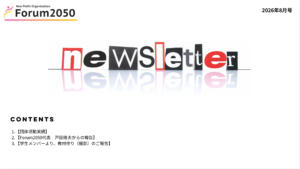
In this August 2025 issue of our newsletter, our President, Toda, writes about “a conversation with our members,” and Makoto Kajita, a teacher member working in special needs education, writes about “opportunities for children to learn from one another and nurture their own ‘thoughts,’ different for each person and true to themselves.”
We also introduce Education Cooperation Week (KKW) 2025, scheduled for September 11, 2025. If you have any questions or comments about the newsletter, please let us know by email or other means. Requests such as “I’d like to know more about this” are very welcome too!
Topics in This Newsletter
- [Our Activities]
- [Monthly Report from TODA Takao, President, Forum2050]
- [Message from Forum2050 Member Makoto Kajita]
- [Event Announcement]
Our Activities
Our main activities in August were as follows.
Aug 10: Exchange of views among the organization’s members
Aug 16: Meeting with the Japan-Ukraine association
Aug 24: “From Suginami: Peace as ‘Our Own Concern,’ Thinking Together,” Suginami City workshop
Aug 31: Exchange meeting with Georgia (planned)
Monthly Report from TODA Takao, President, Forum2050
The intense heat continues even after Obon. I hope you are all well.
According to an acquaintance at a medical institution, COVID is also picking up again.
It would be terrible for an infection to strike when you are already worn out by the summer heat.
Please eat even more nourishing food than usual, do things you enjoy, never overdo it, and take very good care of yourselves.
On the 10th of this month, members of our management team in the Kanto region gathered at my home, with others joining remotely, and we spent half a day talking thoroughly about the future of the organization.
Lately in particular, the number of young members has been growing little by little and our average age is dropping sharply, and this gathering, too, became a place to listen to the views of the young people who will carry the organization’s future. I asked not myself but one of our members, Katsuteru Yamagiwa, to facilitate. Katsuteru is the father of Kanji Yamagiwa (currently in 6th grade), our youngest member, and father and son are both active members of the organization. While working at a publishing company, Katsuteru has been studying organizational development and coaching. Thanks to Katsuteru, we were able to draw out the thoughts of the young people as fully as possible, and we learned a great deal from them.
Until now, the organization’s main activity has been my going out to schools and other places to give talks and hold dialogues with children there, with, in addition, activities led mainly by our young members, such as the exchange meetings with Georgia. Listening to the frank views and thoughts of our young members this time, I came to think that the organization may be reaching a new turning point.
What their thoughts had in common was a strong wish to connect with people in more countries, and eventually with people all over the world. For example, connecting with 30 countries within five years, or no, with all of Africa: in any case, almost everyone said we should set some concrete numerical target. They also spoke of their dream: remote exchange is wonderful, but they want to actually go to countries around the world and talk directly with people of their own generation there.
To the question of what it really means to connect, and how much dialogue it takes before we can say we are connected, one idea was that we are connected once we remember each other’s names and become friends. Another was that they want to know each other’s thoughts (true feelings) about what kind of world they want to create for the future and what they themselves want to do toward that. Someone also shared a dream of sending blank picture books all over the world, so that children in each country make their own picture books, and then sharing them… (In fact, it seems that when this person was in 1st grade, their mother gave them a blank picture book with nothing written in it, to make themselves.)
We also heard the view that, although the organization is small and our activities are limited, if we steadily increase the number of people and countries we connect and hold dialogue with in this way, our partnerships with various organizations and networks might accelerate.
I was very glad that these views came from the young members themselves, one after another, and not because I or other adults told them to do this or that. Someone also said we should strengthen our social media, which I, not being particularly good at social media, found reassuring.
In addition, a young new member who lives in a share house with people from other countries said they want to focus on connecting with foreign residents living in Japan. Specifically, they seem to have in mind creating spaces and communities where those residents can connect with Japanese people. Indeed, foreigners in Japan are often seen from the perspective of work or tourism, but the problems faced by children with foreign roots, and conversely, many of the opportunities to open up something new together with them, are left to busy teachers at schools. I was reminded that it is important for each of us to become more aware of these things.
A member studying abroad pointed out that, while living away from Japan and facing various difficulties, their relationships with the organization’s members have been a source of support, and that this organization, where people across generations can talk seriously about all kinds of things, has become a place where they belong.
(I also thought this was so very typical of our organization!) The young members also came up with the idea that it is important not to limit ourselves to exchanges among young people, but to connect with all kinds of people, from a wide range of generations.
Listening to the young members, the adults were inspired too.
Someone for whom life is hard right now speaks about peace. The individual lives of each person and the big theme of world peace become connected through compassion for life. One person said they would like to try thinking about the importance of peace from that perspective, and that, because they themselves are living while overcoming difficulties, they can now speak about it as someone directly affected…
As the discussion deepened, we heard thoughts like this:
At first, I thought the basic way for an organization to work was for everyone to set concrete goals together and move steadily toward them, but maybe it doesn’t have to be that way. I’ve come to think there could also be a way in which each person contributes to world peace while overlapping their own life agenda with the organization’s activities; in other words, that it’s fine for everyone’s thoughts to be different. Another member said that, rather than suddenly starting to talk (lecture) about war or poverty, what matters first may be to face and connect with people who live in all sorts of ways. Others said that, since we are a young organization, we should take on all kinds of challenges without fear of failure while we are still “young” (as an organization).
And finally, our facilitator, Katsuteru, shared these honest thoughts.
Even when people talk about world peace, many people in society, myself included, are doing all we can just to protect the happiness of the people within a five-meter radius whom we want to protect, such as our families and our companies. We worry about the problems within that circle, and toward bigger things beyond it, like peace or the conflicts happening in the world, we feel nothing but powerlessness. Even so, by coming into contact with people who have such thoughts, human beings come to feel that they want to do something and get involved with the world. What struck me was Katsuteru saying that he wants to reflect on what kind of person he is to feel this way, and to think about how he engages with himself and with the organization.
For me, who usually can’t help talking too much about my own ideas, this exchange of views was a truly wonderful time of learning. And I felt very encouraged that, even while I simply played the listener, such a lively exchange of views was taking place.
Komabashiri, one of our Vice Presidents, says:
“That’s right. Building an organization is building people.”
I really do think so.
And I felt deeply that I would like to spread the good parts of this organization’s culture, or of how people relate to each other within it, to the networks around us and to the society we are trying to reach, and to put them to use there.
As you see in the news every day, conflicts in the world never cease. If anything, compared with a while ago, and especially with the early 1990s, when the Cold War structure collapsed and many people dreamed that peace had arrived, the world situation has certainly worsened, and it seems that people’s hearts have grown sick.
In such a harsh situation, all kinds of people around the world, including some of the most capable people representing their countries, are making all kinds of attempts at all kinds of levels, but there is no sign of improvement at all.
World peace. I want to begin the journey toward peace first with people, with many ordinary people, from within people’s hearts, and above all from within the hearts of the young people who will shape the future.
This time, I have talked only about matters within the organization. I would be very happy if this has helped, even a little, for you to get to know our organization more deeply.
In next month’s September issue, I will tell you about the workshop in Suginami City on the 24th of this month and the workshop at JICA Headquarters on September 11.
We look forward to your continued support!
TODA Takao
Report from Forum2050 Member Makoto Kajita
To our supporters,
Thank you very much for your continued support of Forum2050. My name is Makoto Kajita, and I am a member.
First, let me introduce myself…
When I was in 3rd grade, I met a teacher I liked very much, and becoming a schoolteacher became my goal. Until university I aimed to be an elementary school teacher, but after graduating, a passing remark by my now-husband, who was already working as a teacher, led me to become a teacher at a special needs school (called a “school for the handicapped” at that time). I will never forget the entrance ceremony where I first met children who sat in wheelchairs and found it hard to move their arms and legs or to speak. More than twenty years have passed since then. Though the places and ways I have worked have changed, I have always been involved in special needs education.
To Dhaka, Bangladesh…
In 2008, it was decided that my husband would be sent to the Japanese School in Dhaka, Bangladesh. Starting life overseas with three small children, I felt great anxiety, a vague confidence that “it’ll work out somehow,” and a little anticipation of a life different from before. Life in Dhaka was unlike anything I had experienced. Shopping at local markets while haggling with shopkeepers, choir performances in the foreign community, Bengali dance lessons, and more. All three years were stimulating and fun, but what stays with me most is the presence of people with disabilities and street children. When we went out by car, everywhere we went we saw women turning an armless shoulder toward the car window and saying “baksheesh” (alms), and children coming up to ask us to buy flowers. To deepen understanding of these people’s lives, the Japanese School had a learning activity called the “Bangla Photo Exhibition.” The children at the Japanese School took photos and presented to one another what each of them felt. Among those photos were street children with the brightest smiles. I felt ashamed of myself for having seen these children, who were living each day as hard as they could, as “pitiful.” In Japan today, the number of elementary and junior high school students not attending school is said to exceed 340,000. [Survey on Problematic Behavior, School Non-Attendance and Other Student Guidance Issues, FY2023 (Ministry of Education, Culture, Sports, Science and Technology)] Physical health and mental health. Bangladesh and Japan face slightly different challenges, and it is not simply a matter of deciding “which is better.” Each has its strengths and its challenges, and I feel strongly that what we need is a heart that tries to face them sincerely.
Working in special needs education in Japan…
Right after returning from Dhaka, I went back to working at a special needs school. Support systems for people with disabilities changed rapidly, and with ideas such as “inclusive education” and “reasonable accommodation,” schools came to be expected to provide support and teaching that allow each child to grow up at a local school and lead a rich life after graduation. Nurses were also placed in schools, and children who need medical care, who used to need a parent with them, became able to go to school with support from nurses and others.
A year and a half ago, I retired from the special needs school where I had worked for more than twenty years, and I now teach a special needs class at an elementary school. Every day with the children is full of stimulation, different again from life in Dhaka. “Why do you think that?” “What’s so funny about that?” There are puzzles everywhere, but I think from the children’s point of view, stay close to their feelings, and picture their lives after graduation. Then I support learning activities that help them gain the abilities they need. Life after graduation will not be all excitement. I do this because I hope that, even so, they will lead strong and rich lives.
Seeing people as “disabled”… In Japan today, with various systems in place, I feel we are gradually getting closer to a society where children with disabilities can live without being set apart. But surely what we can do is to let go of the view of people as “disabled” and see each of them as “an individual with their own character,” just like us. Aiming for “opportunities for children to learn from one another and nurture their own ‘thoughts,’ different for each person and true to themselves,” as set out in Forum2050’s philosophy, I will keep working hard. Thank you for your warm support.
Event Announcement
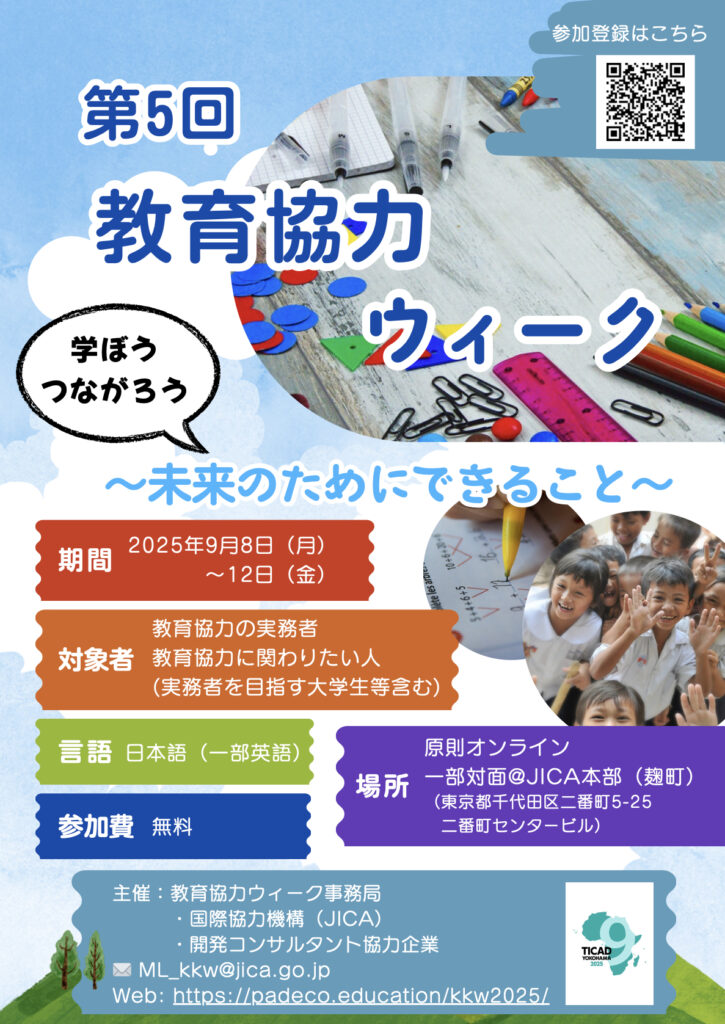
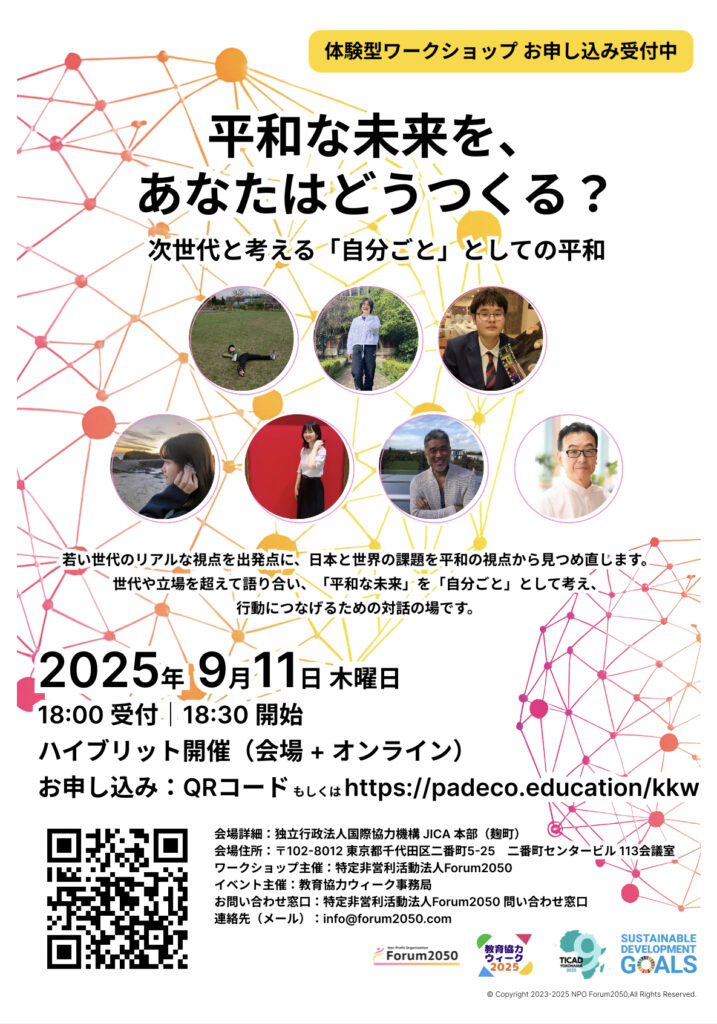
We will be taking part in Education Cooperation Week (KKW) 2025 again this year!
The title of the session Forum2050 is running is “A Future Where Children in Japan and Around the World Connect and Co-Create.”
Why this session, and why now?
There is growing recognition that “educational cooperation” (with developing countries and others) and “development education” (in Japan, including education for international understanding) need to be addressed in an integrated way from a global perspective. At our session at KKW last September, Forum2050, together with participants of diverse backgrounds, including people from JICA, Yokohama City and academia, discussed the significance of efforts on global and Japanese challenges in education resonating with each other, and confirmed the importance of young people taking the lead on this. This time, too, with a wide range of participants, we will think together about “what we can and should do so that the next generation sees the task of co-creating a peaceful future as their own issue.”
Session Details
Date and time: Thursday, September 11, 2025, 18:30-20:00
Format: Hybrid (in person + online)
Venue capacity: 85
Venue: Japan International Cooperation Agency (JICA) Headquarters (Kojimachi), Meeting Room 113
Address: Nibancho Center Building, 5-25 Niban-cho, Chiyoda-ku, Tokyo 102-8012
Session style: Open discussion
Language: Japanese
Registration and inquiries website: https://padeco.education/kkw2025/
* Registration form: https://forms.office.com/r/9ZujszyiX5
Inquiries about Education Cooperation Week as a whole
Email: ML_kkw@jica.go.jp
Web: https://padeco.education/kkw2025/
Inquiries about the Forum2050 session, email: info@forum2050.com
Inquiries and Consultations | Newsletter Registration
Forum2050 operates under the concept of ‘Children of the World: Each Child’s Vision for the Future Shapes Humanity’s Destiny,’ collaborating with businesses, schools, educational institutions, and others. Together with children, we create opportunities for them to contemplate peace and development in the future human society, fostering partnerships.