![NPO法人 Forum2050[Nonprofit Organization Forum2050]](https://forum2050.com/wp-content/uploads/2024/02/Forum2050logo.png)
Dear supporters,
Hello.
This is Takuzo Komabashiri, PR officer for Forum2050.
In last month’s October newsletter, I wrote about the border conflict between Cambodia and Thailand. After that, on the 26th, the prime ministers of the two countries signed a joint declaration toward peace in Kuala Lumpur, witnessed by U.S. President Trump and others, and it seemed that implementing the declaration would be the next focus. However, on the 10th, after several Thai soldiers were injured by a landmine explosion on the border, Thailand announced that it was suspending implementation of the peace agreement with its neighbor Cambodia. One of the injured soldiers suffered a serious injury and lost a leg; even if the conflict ends, that wound will never heal. There has been no new progress since then, and I am keenly aware of how steep the road to peace is.
This November 2025 issue of our newsletter reports on three things: (1) the results of our activities so far, (2) the direction we will take as an organization, and (3) what we learned in Nagaoka, which we visited this month.
If you have any questions or comments about the newsletter, please let us know by email or other means. Requests such as “I’d like to know more about this” are very welcome too!
Topics in This Newsletter
- [Our Activities]
- [Monthly Report from TODA Takao, President, Forum2050]
Our Activities
Our main activities in November were as follows.
Nov 8: Dialogue with students in the Nagaoka City Global Leader Program (35 junior high, high school and university students)
Nov 20: Dialogue at Nishi-Kamakura Elementary School (347 students in grades 4 to 6)
Monthly Report from TODA Takao, President, Forum2050
Dear everyone,
Only a little over a month of this year remains. I hope you are all keeping well.
This month, I would like to report on three things: (1) the results of our activities so far, (2) the direction we will take as an organization, and (3) what we learned in Nagaoka, which we visited this month.
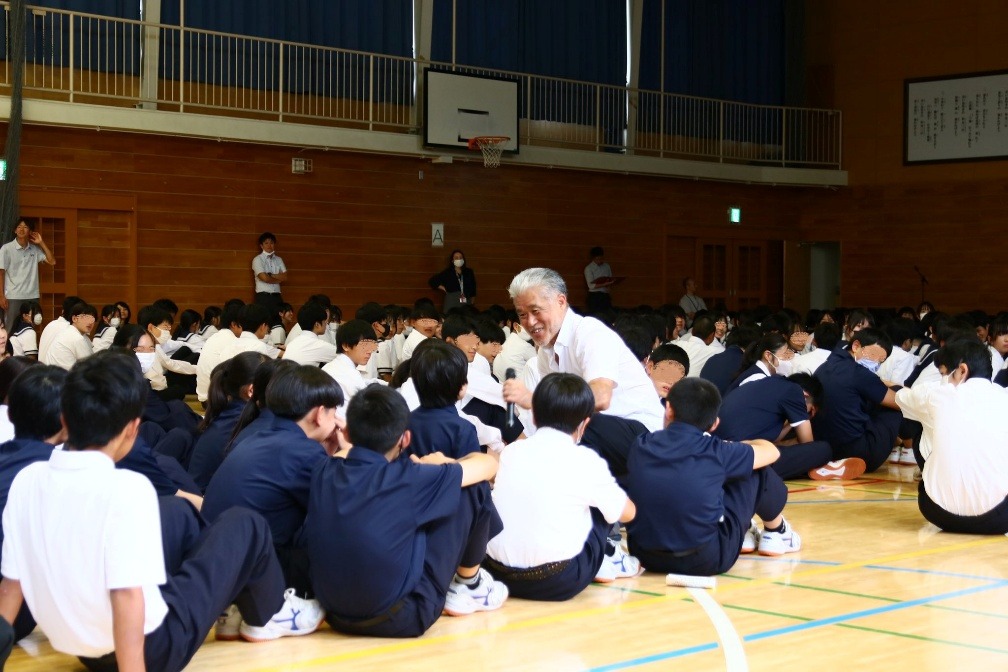
Dialogue at Wako City Daisan (No. 3) Junior High School
New learning about the results of our activities
Thanks to you, Forum2050’s activities have gradually become known to people at schools and in local governments. Our first full-fledged talk as an organization was at Hatayama Junior High School in Seto City in October 2023. In the two-plus years since then, we have given talks, or held dialogues, though in very limited time, with more than 9,300 young people and children, from 4th graders in elementary school to graduate students (including international students), at more than 50 schools and other venues. If we add the exchange meetings run by our young members, the activities of our members overseas, and open classes and collaborative events with JICA and local governments, the number probably easily exceeds 10,000.
However, as has also been pointed out in our internal discussions, these numbers are not what matters; the real question is the substance. It is not simply that we talked to them. What matters is how the hearts of young people and children changed and grew as a result, how much their interest in the future world increased, and how much their desire to create the future together with others grew. We believe it is important that this be made clearly visible as the outcome of our activities.
On this point, as I reported before, we have made an interesting finding in analyzing the surveys we conduct before and after our activities at schools and elsewhere. The analysis was done by Hisanaga, a member of our management team and a data scientist. It still needs further verification, but the hypothesis that emerged is as follows.
[Step 1] (Through intervention/stimulus such as talks and dialogue on co-creating the future) interest in the future world increases.
[Step 2] (As a result) the wish to know more about the wider world, and the wish to connect with and understand different people, grow stronger. Or the feeling that one’s connections with the world and with other people support one and keep one going grows stronger.
This is the result of Hisanaga’s analysis of data from the surveys conducted before and after our talks and dialogues so far, using a recent data analysis method called “Peter-Clark causal inference” (sorry, I, Toda, can’t explain it accurately💦). We plan to take this research further with outside academics and with Kajita, a member of our organization who heads a school.
From here on, this is my (Toda’s) wishful thinking, but I believe there may be a further “Step 3” beyond this.
[Step 1] (Through intervention/stimulus such as talks and dialogue on co-creating the future) interest in the future world increases.
[Step 2] (As a result) the wish to know more about the wider world, and the wish to connect with and understand different people, grow stronger. Or the feeling that one’s connections with the world and with other people support one and keep one going grows stronger.
[Step 3] (As a result) this may have some positive effect on the “difficulty in living” of young people and children who lack or have not yet developed prosocial behavior, or who struggle with their connection to society, and may in turn help raise their well-being.
As I have mentioned before, as I visit schools, not a few of the children I meet frankly tell me something like, “Something as big as world peace doesn’t really mean anything to me. What matters far more is how to make my life now, and the environment I’m in now, easier to live in.” To be honest, shouting at such children that “You are the ones who will create the future world” or “World peace is very important, so let’s think of it as our own issue” does not get through to them easily.
What do we do then?
In my case, I have tried to win children’s interest and empathy by confessing to them my “personal history of finding life hard,” which I carried from early childhood into adulthood, and by talking about how it came to be untangled through my connections with the world and with the future: my own experiences, especially the failures and the moving moments in the field of international cooperation.
How well has this approach worked? We need to evaluate that objectively, so that we do not simply draw conclusions that suit us. But at least from the children’s voices and the change in how they answered the surveys before and after, I do feel some sense that it is getting through. We want to deepen our insight into this by actively learning not only from Hisanaga, Kajita and others in our organization but also from outside experts. Our immediate goals are to submit a paper to an academic journal on social-emotional education, and, although the bar is very high, we are also considering submitting to an international academic journal on peace education and related fields.
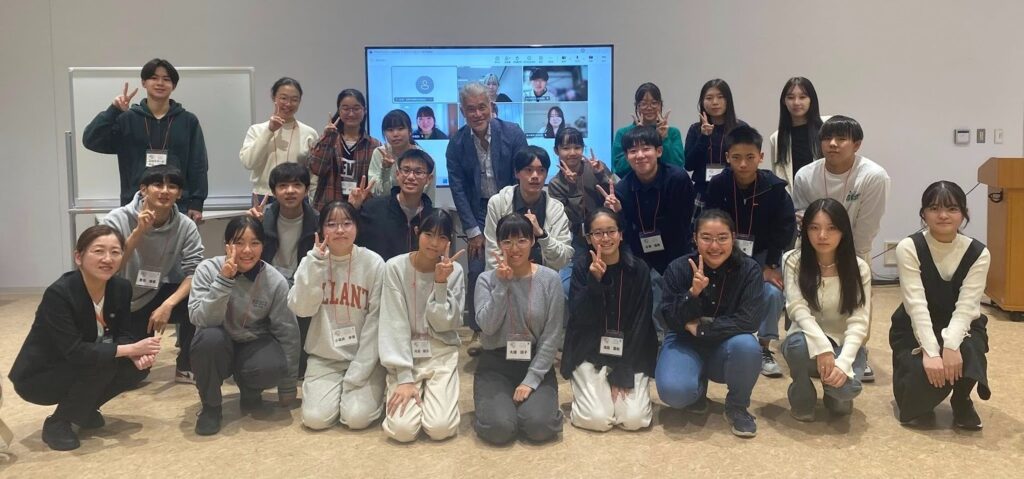
Dialogue at an event hosted by the Nagaoka International Association
The direction we will take as an organization
The reason Forum2050 exists is not only the framework in which I, as President, and our Vice Presidents with experience in international cooperation (Vice President Komabashiri is posted in Cambodia and Vice President Shoji in Bangladesh) give talks and hold dialogues, with the organization supporting them. Of course, we intend to keep refining and continuing these activities, but we have a much bigger dream. (Note: if a “dream” is something personal, it may be better to call it an “aspiration,” something that can be shared with many people.)
That is to create and run the global public good we call “Imagine2050,” which we have explained several times before: a platform where young people and children take the lead, connect across borders and differences in culture and language, share their thoughts about the future world, and gain the learning to create the future together. Thanks to you, as we gain valuable learning from our talks and dialogues, we are now discussing within the organization that we must seriously consider moving on to the next stage as an organization.
Naturally, a very, very small organization like ours cannot achieve such an enormous aspiration on its own. In reality, our role may be limited to whether we can win the empathy of many powerful stakeholders and light the fire of their passion, so that the world begins to move in that direction. But however far we can go, there is one thing that is indispensable on the way there: to present concrete content to be shared among people on such a platform as a global public good, and to make it visible.
I am sorry this has become a little abstract. To put it in terms closer to the classroom, the first step for now is something close to creating interesting content (teaching materials and learning guidelines, for example) that moves children’s hearts about “co-creating the future world.” Having teachers, as well as well-known people and adults with rich experience, speak to children is of course important. But our experience so far shows that something matters even more: sharing how children of the same age, in a variety of situations, speak frankly. This creates far more impact.
We want to move discussions on this forward inside and outside the organization while involving experts, and turn them into concrete activities of our organization.
Specifically, we will think and act with a view to developing in the following way:
[Until now] Through talks and dialogues, deepen our learning about what moves and nurtures children’s hearts.
[From now on] While continuing our talks and dialogues, create spaces where children learn from one another through their own words and dialogue, and gather these as “teaching materials” (material/content for learning).
This month, at the invitation of the Nagaoka International Association, I held a dialogue with young people (from 1st-year junior high school students to university students) on the theme “What can we do to think about a peaceful future?” They had chosen to take part in this event, spending their own time and money, and some of them were going on afterward to an event in Hawaii about the attack on Pearl Harbor. They seemed to have a stronger interest in a peaceful future than most young people.
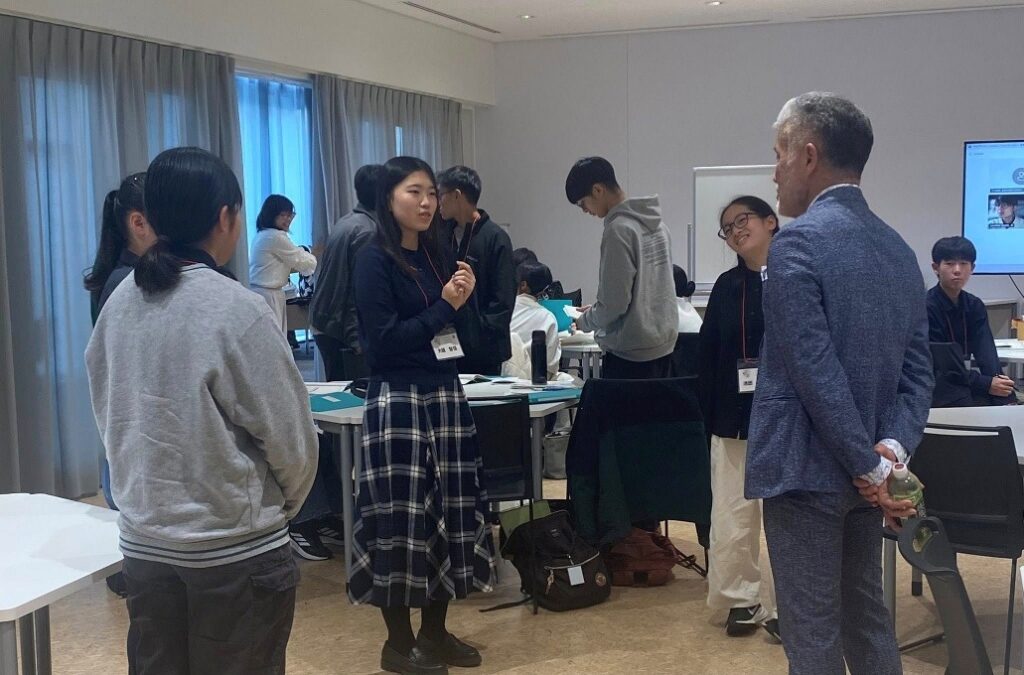
At the event in Nagaoka City, we were able to talk things through relatively thoroughly, but…
However, as the dialogue went on, their frank true feelings and confusion came pouring out: “I’m worried about how to deal with the rapidly growing number of foreigners in Japan.” “I feel angry at the attitude and behavior of foreigners who seem to be using Japan only for economic gain.” “(After I talked about how hard it is to break the cycle of hatred) The world peace I was thinking about in my head and the way my heart actually reacts are far apart. I realized that thinking of peace as my own issue is actually not that easy.”
I was very glad that they opened their hearts and spoke frankly about what they felt. At the same time, I thought that this very process of their worries and confusion might be what moves the hearts of young people and children of their generation, and give each of them a chance to think for themselves about how to create the future world.
I mentioned earlier that, while our main activities so far have been talks, dialogues and online exchanges, we now intend to move to a new stage and get our activities toward Imagine2050 going. My experience in Nagaoka was a valuable opportunity that made me keenly feel the need for both of these kinds of activities.
At the same time, though, this has also revealed new challenges. With talks and dialogues, it was enough for me or other members to give our time as storytellers. But creating content for Imagine2050, for example, takes much more time, effort and money. How to raise that, and how to build up and strengthen the structure we need for it, have emerged as major challenges. There is no simple, easy answer to this. But even so, we have renewed our resolve to keep walking, without stopping, with our eyes on the distant North Star.
Please continue to lend us your strength.
Thank you so much!!!
Finally, as the winter cold sets in, please take very good care of yourselves.
Nov 20, 2025
In Koenji, Suginami City
TODA Takao
Email: toda@forum2050.com
Inquiries and Consultations | Newsletter Registration
Forum2050 operates under the concept of ‘Children of the World: Each Child’s Vision for the Future Shapes Humanity’s Destiny,’ collaborating with businesses, schools, educational institutions, and others. Together with children, we create opportunities for them to contemplate peace and development in the future human society, fostering partnerships.