![NPO法人 Forum2050[Nonprofit Organization Forum2050]](https://forum2050.com/wp-content/uploads/2024/02/Forum2050logo.png)
Hello. This is Takuzo Komabashiri, PR officer at Forum2050. This time, let me start right away by spreading the word about one of our young members. Akari Itaya, who takes part in Forum2050’s activities while attending university, has been featured in the “Teens to Watch” directory. Please do read the message from Akari, who says, “What got me to take action was one girl and a picture book”!
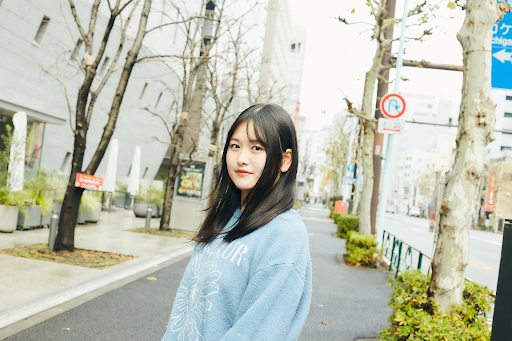
It started with a picture book and TV. A university student aiming for a society where children around the world can share their dreams [Akari Itaya, age 19]
Steenz https://share.google/GbWEGveiL3rZ1FBld
In the February 2026 newsletter, we report on the data analysis of the surveys conducted at our talks and dialogues, carried out by Ryuya Hisanaga, one of our young members (a data scientist).
In addition, Vice President Akihiro Shoji, based in Bangladesh, reports on the results of the general election held there on February 12.
We also have a report from Sara Komatsu in Georgia, a JICA Overseas Cooperation Volunteer, on “Soreiyu (provisional name),” the online international exchange session run mainly by Sara and our young members. Please enjoy it along with the beautiful photos.
If you have any questions or comments about the newsletter, please let us know by email or any other way. Requests such as “I’d like to know more about this” are also very welcome!
- Topics in this newsletter –
- [Our Activities]
- [Report from TODA Takao, President, Forum2050]
- [Messages from Members] The general election in Bangladesh
- [Message from Sara Komatsu, JICA Overseas Cooperation Volunteer working in Georgia]
Our Activities
Recent main activities and events
Jan 21 – Feb 20
- Jan 26: Exchange of views with Yokohama City and the general incorporated association Katawara
- Jan 29: Visit to Yasuaki Yoneyama, former Special Representative, Tokyo Office, World Bank
- Jan 29: Exchange of views on the future of the exchange sessions with Georgia
- Jan 30: Talk and dialogue at Seto City Hatayama Junior High School, Aichi Prefecture
- Feb 2: Visit to Vice Principal Yoshinobu Kataoka, Kawasaki City Mukogaoka Elementary School
- Feb 9: Visit to the JICA Overseas Cooperation Volunteers Secretariat (Director General Otsuka and Senior Advisor Wada)
- Feb 11: Exchange of views with Shinya Sawamura (House of Joy children’s home)
- Feb 12: Exchange of views with Yuta Takahashi (Katawara)
- Feb 16: Analysis of the impact of our talks (Dr. Iwashita of Tokyo Women’s Medical University and others)
- Feb 16: Meeting with Yokohama City (regarding the UN Peace Circle)
Report from TODA Takao, President, Forum2050
Dear all,
There are still occasional bitterly cold days, but the sunshine has grown warm enough to hint at spring. How are you all doing?
“Are our activities reaching children’s hearts?”
On this question, first of all, I would like to share something that made me happy, even though it is a very small thing.
■ Our third try at Hatayama Junior High
On January 30, I spoke with about 160 students: the 2nd-year students and the students in grades 1 to 3 of the special-needs classes at Seto City Hatayama Junior High School in Aichi Prefecture.
This was my third time speaking at the school. I am grateful to the school for inviting me, and especially to Principal Kajita.
Within the framework of the “Ways of Living” lecture, this time we were given plenty of time: two sessions of 50 minutes each.
The theme was “The Future Me and the Future World.”
As always, the aim of the dialogue was for the young people who took part to become even a little more interested than before in the future of the world, as their “own issue.”
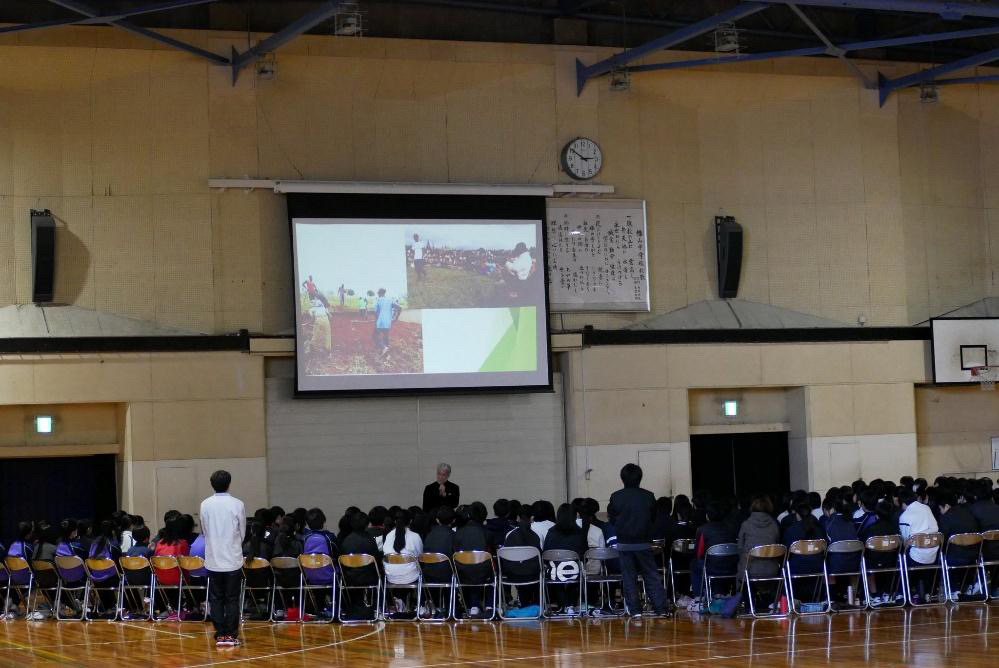
January 30, with the 2nd-year students and the grade 1 to 3 special-needs class students of Hatayama Junior High School.
Even in a freezing gym, after a while you forget the cold?
■ A change in the children who say “That has nothing to do with me”?
This time, we asked Ryuya Hisanaga, one of our young members (a data scientist), to analyze the survey data collected at this talk and dialogue.
As I have explained before, we give the same survey before and after each talk to estimate what changes took place in the children’s hearts, focusing on (1) a sense of connection with the world, (2) feelings of gratitude, (3) willingness to seek mutual understanding, (4) interest in the future world, and (5) motivation to act for the future world.
Until now, my own analysis could only look at the overall movement through averages. This time, we extracted the change in each individual and looked in particular at what changes can be inferred among the children who initially showed negative or passive response attitudes on the five items above.
The results are shown in the figure below. In summary, on all five items, more than half of them shifted their response attitudes in a positive direction, and on the sense of connection with the world and the motivation to act for the future world in particular, more than 80% shifted to a positive attitude.
[Figure] The impact of the talk and dialogue at Seto City Hatayama Junior High School
(An analysis focused on changes in negative response attitudes)

(Prepared by Ryuya Hisanaga)
There are many excellent activities in peace education and in education for cross-cultural understanding and a multicultural society.
To take a deliberately critical view, though, I had felt that there tends to be a gap between eager children who listen with interest and children who do not, and that the impact on the latter was not always clear.
Through our activities, I myself have kept asking: “Are we really reaching the children we most want to reach?”
This time, however, I thought once again how truly glad I would be if we had been able to stir, even slightly, the hearts of children who had said “The world has nothing to do with me” or “I’ll live my life on my own.”
■ The limits of the lecture format? Working on mutual understanding
There was one more important lesson here. The changes across the five items were not uniform; in particular, the impact on “willingness to seek mutual understanding” was relatively small.
This had already appeared in the overall averages before, but this time we found that it showed up clearly in the group with negative response attitudes.
I have come to think this may be a limit of the so-called lecture-style approach.
It is rather natural to feel that understanding people who live in very different circumstances and hold diverse ideas and values is not easy.
For children to want to overcome that and take on the challenge, it is important for society to offer them many more such opportunities.
It is also important to “reframe” the opportunities close to children, especially chances to connect with children of foreign nationality, in this way. And if children come to find it “fun” to connect and understand one another there, I believe such opportunities will continue, take root and grow.
Of course, this is easy to comment on with a knowing look, and not easy to actually put into action.
But I truly feel lucky, because right when I was turning these thoughts over, there was another happy change, and I would like to report on it as well. (Sorry this has become so long 💦)
■ A new way forward, found through the initiative of young members
I have reported before on our exchange sessions with Georgia. Now, on the initiative of our young members, voices have arisen among them to expand and develop these sessions into exchanges among young people and children from many more countries and regions, not just Japan and Georgia.
These exchange sessions were started from the outset on the initiative of Maaya Fujimoto and other young members, have now been held eight times, and the conversations deepen each time.
Sara Komatsu (a JICA Overseas Cooperation Volunteer dispatched to Georgia), who has been working with us on the Georgian side and will, I believe, be contributing to this month’s issue, is also positive about this direction, and the mood is building to expand it together.
Please let me continue reporting on this, including on the exchange session planned for the 22nd of this month.
On issues such as cross-cultural understanding and multicultural coexistence, where I thought lecture-style activities might have limits, I feel that exchanges among young people themselves are clearly, and far, more important and effective.
On February 9, together with three young members, Akari Itaya, a member since our earliest days, Kanji Yamagiwa, our youngest member, and Hana Miyoshi, who came up from Osaka, I visited the JICA Overseas Cooperation Volunteers Secretariat and explained to JICA’s senior staff our dream of developing these exchange sessions together with the volunteers. Director General Otsuka and Senior Advisor Wada welcomed us warmly. They also showed the three members around the JICA workplace. Personally, I was very happy to run into old friends unexpectedly.
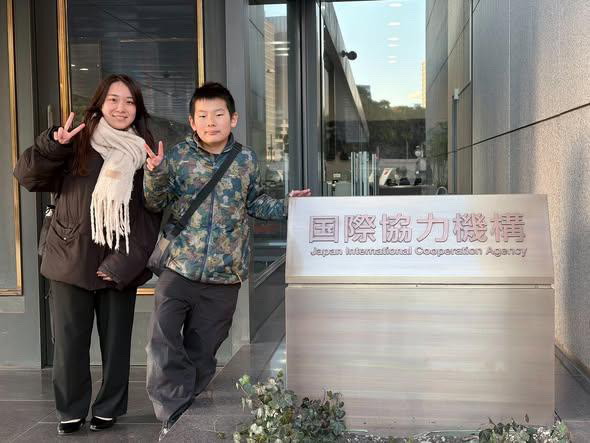
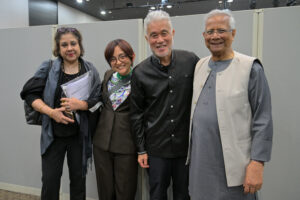
Hana Miyoshi and Kanji Yamagiwa on their first visit to the JICA Overseas Cooperation Volunteers Secretariat in Takebashi. Akari Itaya joined us afterward.
(It’s a real shame we forgot to take a group photo including Otsuka and Wada of JICA and Itaya 💦)
■ Young people’s steps change an organization
Finally, one more thing about how we run the organization.
One of the most important events for running and building the organization is our weekly regular meeting.
We hold it online every Sunday at 8 a.m. (because of the time difference, for nearly three years Vice President Shoji in Bangladesh has been getting up before 5 a.m., and Vice President Komabashiri before 6 a.m.!). Since mid-January, our young member Yuika Tsukuba has volunteered to chair it.
In the limited, busy morning time, drawing out diverse opinions from members of all ages and backgrounds, from elementary school students to seniors, and finding a direction as an organization, is no easy role. Until now, either Vice President Shoji or I had taken it on, but with Yuika running the meeting, its atmosphere has changed completely. There seems to be something essentially and decisively different between me, at 65, asking “What do you think?” and Yuika asking it. And watching this, Kanji also remarked, “Maybe I’ll try chairing too.”
I feel we have climbed another small but important step toward becoming “a multigenerational organization led by young people.”
Thank you for reading this far.
I look forward with all my heart to seeing you again on many occasions. As an organization we still have many shortcomings, but we will keep moving forward humbly and with all our effort, so we would be grateful for your continued advice and support. And if you would be willing to spare some of your valuable time to talk with us, we would very much like to speak with you, so please feel free to reach out.
Finally, here in Japan, pollen has started flying in the Kanto region over the past few days; please do take good care of yourselves.
Feb 19, 2026
Koenji, Suginami City
TODA Takao
Email: toda@forum2050.com
Facebook: https://www.facebook.com/takao.toda.54
X: https://x.com/forum2050?s=21&t=-jQeTjzOoHjrmEbKJvNwNg
Message from a Member: The General Election in Bangladesh (Akihiro Shoji, Vice President)
Four days after Japan’s general election, which drew great attention as the LDP led by Prime Minister Takaichi won a landslide, a general election was also held on February 12, 2026, in Bangladesh in South Asia, where I have been based for many years. Many citizens lined up at polling stations that opened at 7:30 a.m.; it was a long-awaited election after about a year and a half. In July 2024, an anti-government movement led mainly by students and young people gained momentum, and on August 5 of that year then-Prime Minister Hasina fled the country by helicopter. Three days later, on August 8, Muhammad Yunus, one of the world’s best-known Bangladeshis and a Nobel Peace Prize laureate, took office as head of the interim government (Chief Advisor, a prime-minister-level post), and for about a year and a half the government led by Yunus governed the country on an interim basis while preparing for the general election. The former ruling party, the Awami League, led by Prime Minister Hasina, who fled to neighboring India, was condemned for 16 years of dictatorial rule and was not allowed to take part in this election.
The results were announced by the Election Commission on February 13, the day after the vote. The Bangladesh Nationalist Party (BNP), which since shortly after independence has been the main rival of the former ruling party in an effectively two-party system, won a landslide with 209 of the 300 seats in the unicameral parliament, more than a two-thirds majority (212 seats including the 3 won by allied parties). This had been expected from the start. Among the other major parties, Jamaat-e-Islami (JI), which won 68 seats, became the largest opposition party. JI has been described as Islamic fundamentalist and has been kept at a distance by moderate Muslims; although it is the largest Islamist party, its record until now was 17 seats (2001), so winning even 50 seats was expected to count as a big gain. Its winning as many as 68 seats may show that the people of Bangladesh are disgusted with the old-style secular parties (the Awami League, the BNP and others), where corruption is taken for granted, to the point of accepting a somewhat stricter Islamism.
The National Citizen Party (NCP), centered on the young people who openly led the 2024 upheaval, has a leader in their twenties, and its senior figures served at minister level (Advisors) in the interim government; until last year it showed a presence that looked set to become the eye of the storm. Before the election, however, as most expected, it formally announced a coalition with JI, and former student movement groups unwilling to lean toward Islamism left the NCP amid internal strife. In the public eye, too, the view grew that the inexperienced NCP had been swallowed up by JI, and that, as had been whispered since right after the upheaval, the students and young people (now NCP leaders and others) had merely been put out front while JI and the BNP were acting behind the scenes, so that the young people were in effect puppets. Partly as a result, the NCP won only 6 seats, strengthening the impression that it had been swallowed up by JI.
The BNP should understand that it was not so much actively and positively supported by the people, as that its biggest rival, the Awami League, was absent, and that JI and the NCP, which it faced, struggled to gain support because of their Islamism or inexperience. Unless it recognizes that it was chosen by a process of elimination and governs with humility, it will quickly lose public support. The BNP’s current leader, Tarique Rahman (the son of a military hero of independence and former president, and of that former president’s wife, a former prime minister who died at the end of last year; he returned home last Christmas after 17 years in exile in the United Kingdom), immediately told supporters not to get carried away, and instructed them to offer special prayers at mosques on Friday, the day after the election, rather than hold celebration parties.
Looking ahead, the challenges are piling up: how to handle the July Charter, which was put to a YES/NO referendum on the same day as the general election (it sets out the reform agenda decided by the interim government after the 2024 upheaval; about 70% of voters said YES, so the new government must implement its contents as policy); how to come to terms with JI and Islamism now that JI is the largest opposition party; how to deal diplomatically with worsening relations with neighboring India; and whether it can run a stable government, including local politics, while excluding the experienced Awami League officials and supporters who have run the country for nearly the past 20 years.
As an individual living in Dhaka, I felt that although the young people’s slogan in the 2024 upheaval was “Reform,” what happened was more of a “Replace,” with other people simply taking the place the Awami League left behind. So I sincerely hope the new government will push ahead with reform, not only in foreign affairs but also in domestic affairs, where the interim government struggled (reform that builds on what has been accumulated in the past, rather than experiments, rejection of the previous government, or ideas off the top of one’s head).
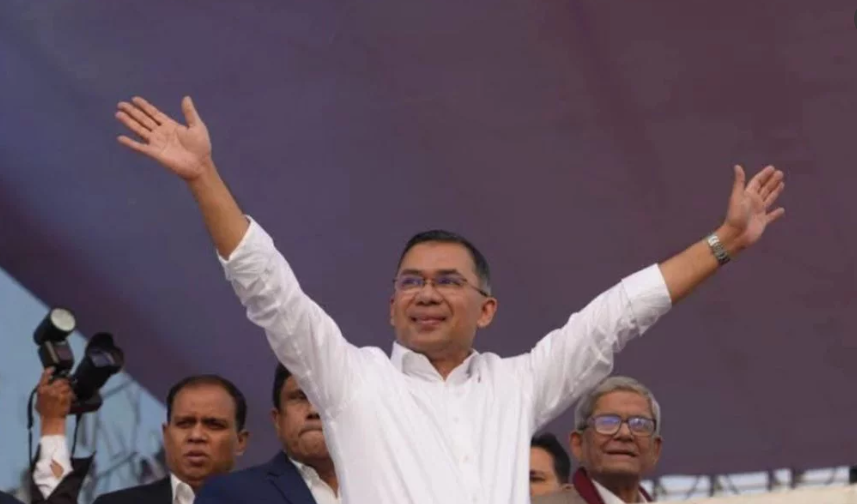
BNP leader Tarique Rahman after the general election victory
Source: Dhaka Tribune (web article, February 13, 2026, “All eyes on Tarique Rahman as BNP set to form government” https://www.dhakatribune.com/bangladesh/politics/403264/all-eyes-on-tarique-rahman-as-bnp-set-to-form)
Message from Sara Komatsu, JICA Overseas Cooperation Volunteer Working in Georgia
Nice to meet you!
I’m Sara Komatsu, a JICA Overseas Cooperation Volunteer doing youth work at an NGO in Georgia.
Thanks to the connections people made for me, for about a year I have been planning and running the online international exchange session “Soreiyu (provisional name)” together with Forum2050 members, about once every two months. This time, I’d like to introduce the online international exchange sessions we have held and look back on what we have done so far.
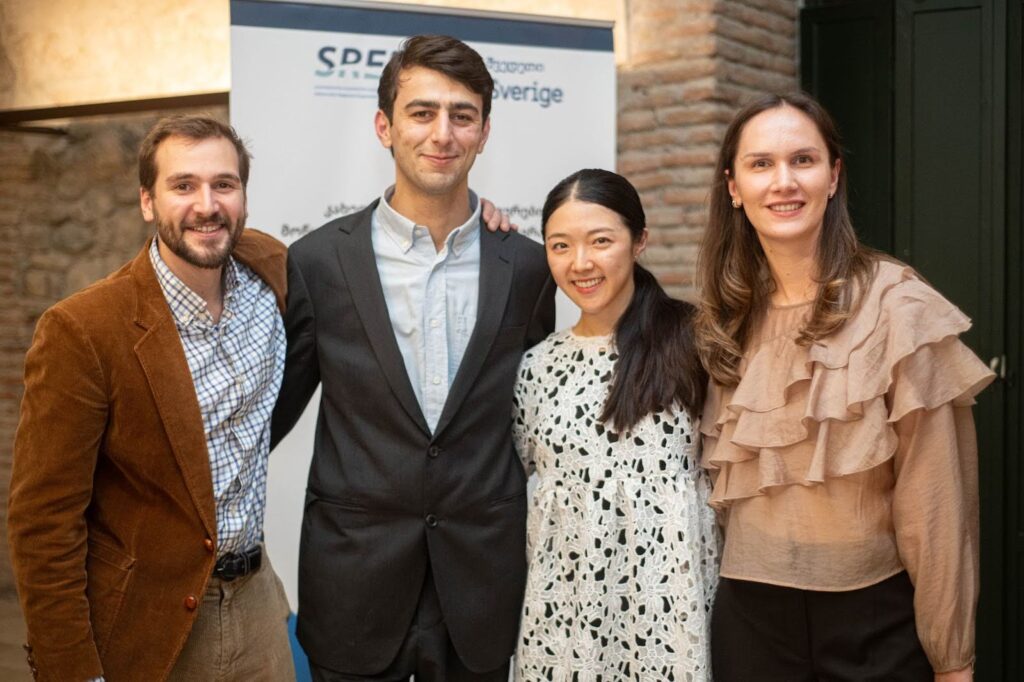
Photo: With my colleagues at my host organization. I’m second from the right. Our team of four, the two Georgian colleagues on either side of me, the Peace Corps volunteer on the far left, and me, is in charge of a youth activity project.
About Georgia
Georgia lies on the border between Eastern Europe and Western Asia and is sometimes called “the crossroads of Europe and Asia.” It has a population of just under 4 million and an area slightly smaller than Hokkaido, a small country compared with Japan.
Because of its geography, surrounded by large powers, it has been occupied by other countries many times in its history. But through the strong will and efforts of its people, it has preserved many unique traditions, such as its own language, Georgian, and a wine culture said to be the oldest in the world, with its own native grape varieties. Thanks to its rich nature and geographical background, many ethnic groups live in the country, and each region has its own strong character, which is another of its charms.
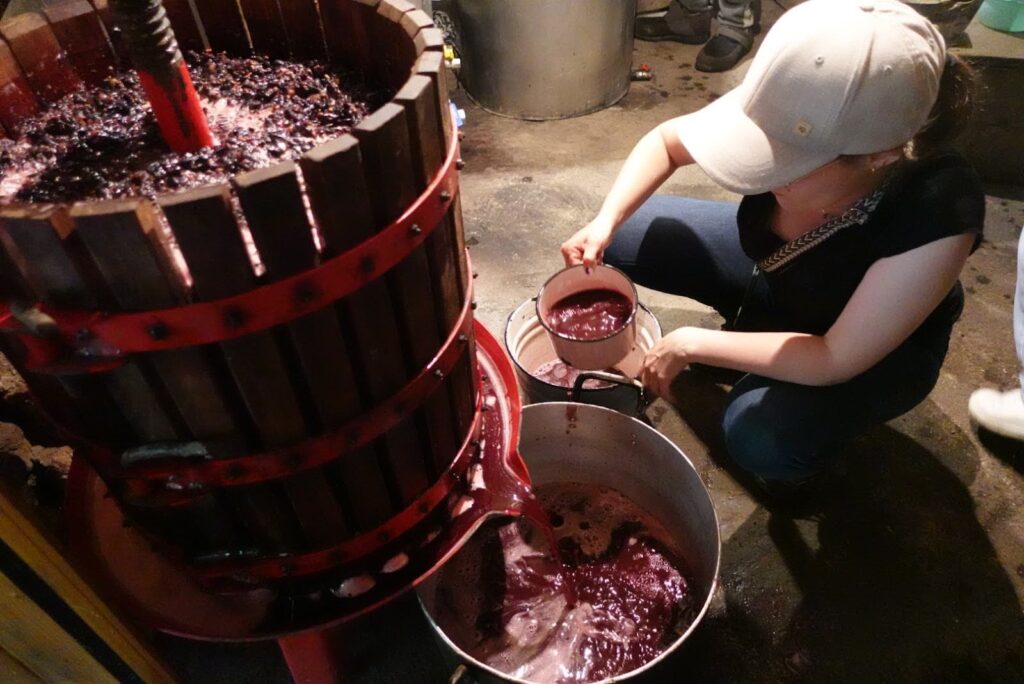
Many households grow grapes. Every autumn they harvest them and make wine at home.
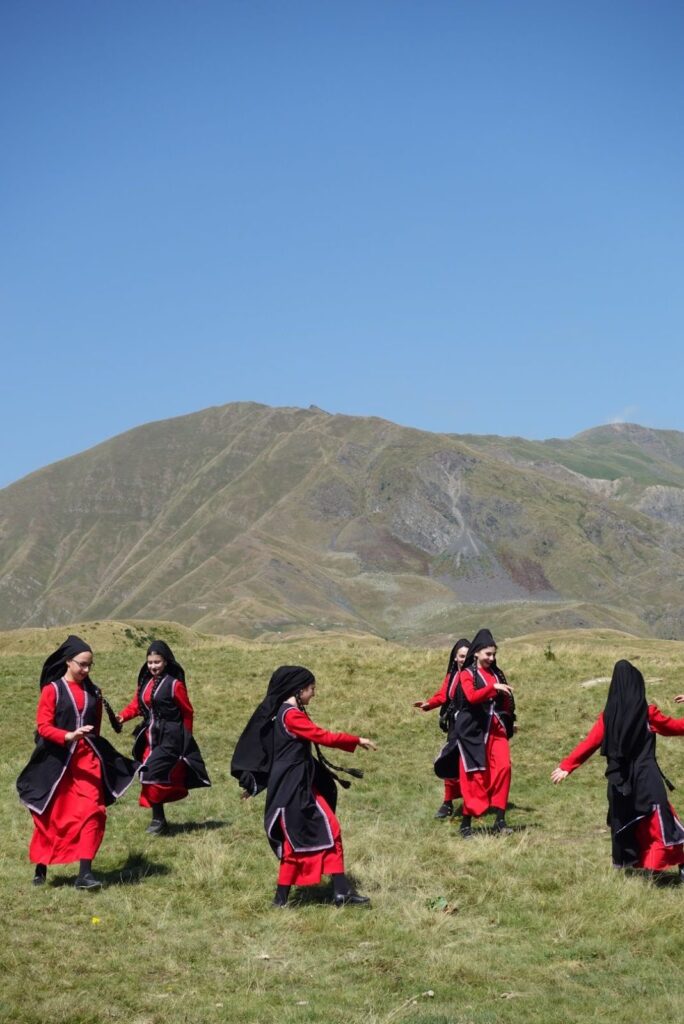
Students in traditional dress dancing at a festival of the Tush, a Georgian mountain people
I am posted to Akhmeta Municipality in the Kakheti region of eastern Georgia. Within it, I work mainly in the Pankisi Gorge, where many Kists, Chechen Georgians, live. The national church of Georgia is the Georgian Orthodox Church, but most Kists are Muslim. I work to expand educational opportunities for the Kist community, which lives as an ethnic minority, especially for young people and women.
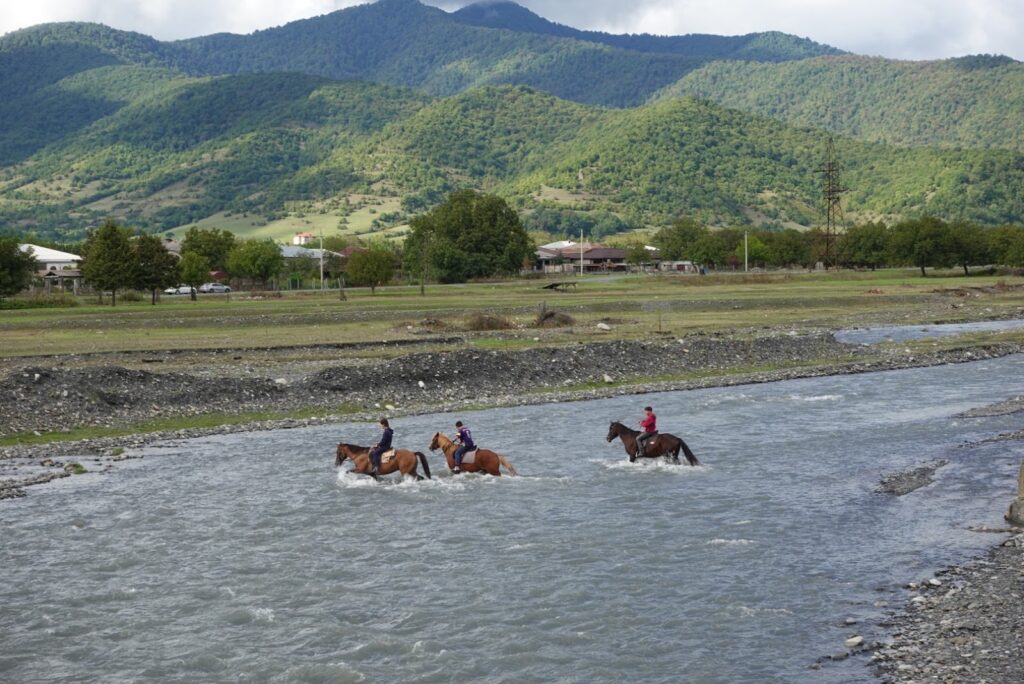
In the Pankisi Gorge, getting around on horseback is part of everyday life! Kist children crossing a river on horseback
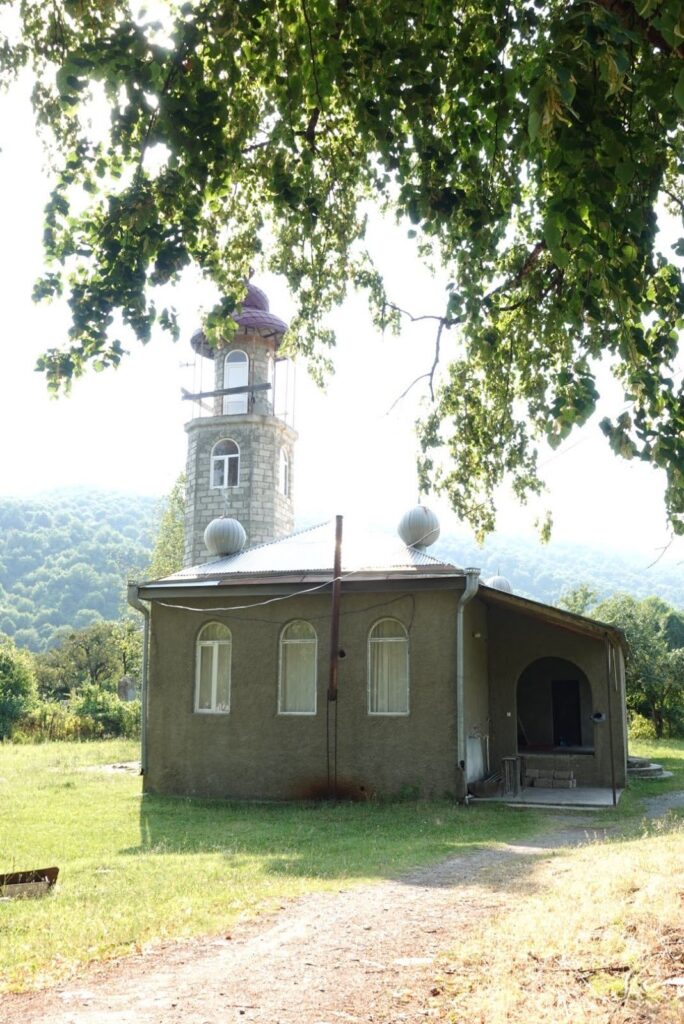
The mosque of the Kist community
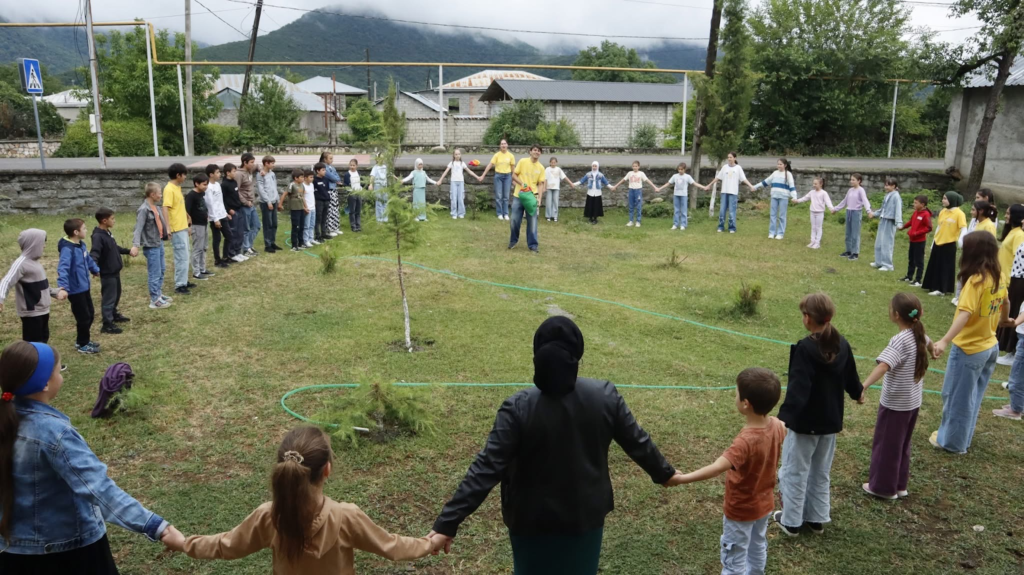
A summer camp planned by junior high school students in Akhmeta Municipality for elementary school children
What does the “Soreiyu (provisional name)” exchange session do?
The exchange sessions are run mainly by Forum2050 members and participants from Georgia. With each session, more participants have joined from around Georgia and from across Japan.
At first, it was a place to introduce each other’s countries and cultures and simply enjoy the exchange. Now, through regular sessions, trust has been built, and we can dig deeper into shared themes.
For example, on the theme of “peace,” Forum2050 members took the initiative and talked with young people of the same generation from the Kist community about “peace as one’s own issue.”
When we split into two groups to define peace, Group A described it as “a calm everyday life,” and Group B as “freedom with rights.”
There is no right answer. It became a time to share why each group thought that way and what lay behind it. Differences in values are shaped by the environment we grew up in and the experiences we have had.
It was a memorable time that reminded me how important it is to make the effort to learn how people around the world live, and to be able to imagine how others feel.
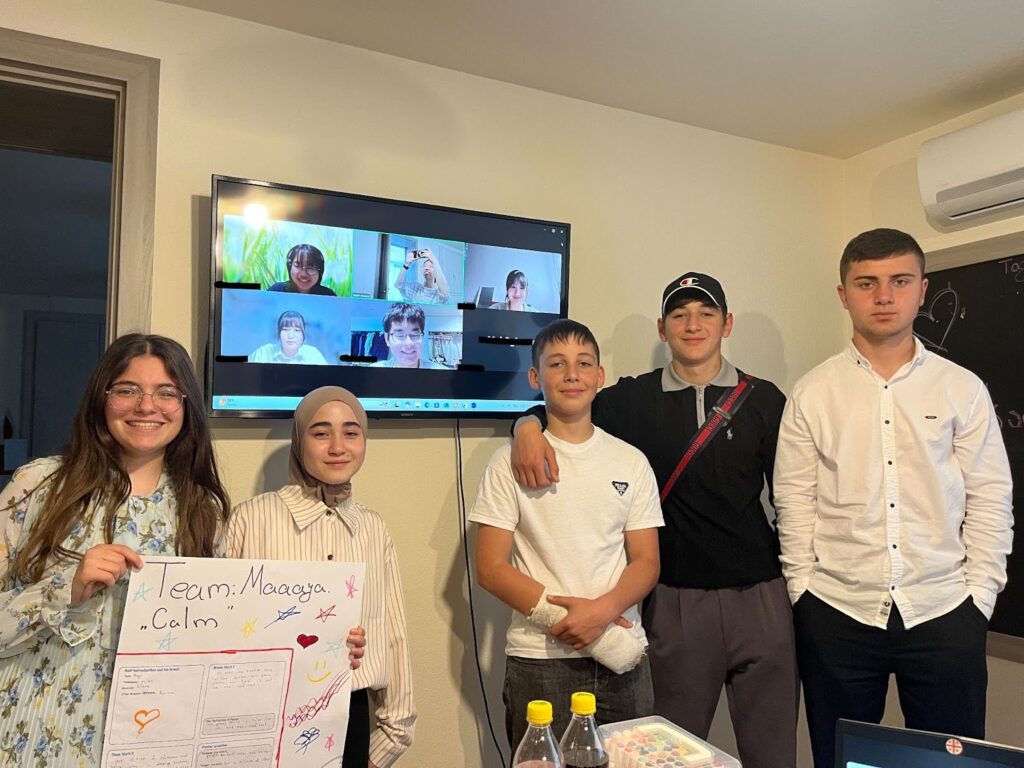
The session on the theme of peace
Seeing how both sides in each team respected each other and tried to understand one another, and seeing the participants exchange reluctant goodbyes as the activity came to an end, moved me deeply.
In another session, participants from elementary school children to adults exchanged views on the theme of “education,” across countries and generations. With participants from Japan, Georgia, Bangladesh and the United States, there were many moments when people were surprised by the state of compulsory and higher education in each other’s countries. I was struck by the story that in Bangladesh, a single class can have more than 100 students.
Sharing each other’s situations also became a chance to notice points for improvement and hints for solutions.
Questioning what we take as “normal” opens up new perspectives for creating a better environment. I feel this is one of the strengths of international exchange.
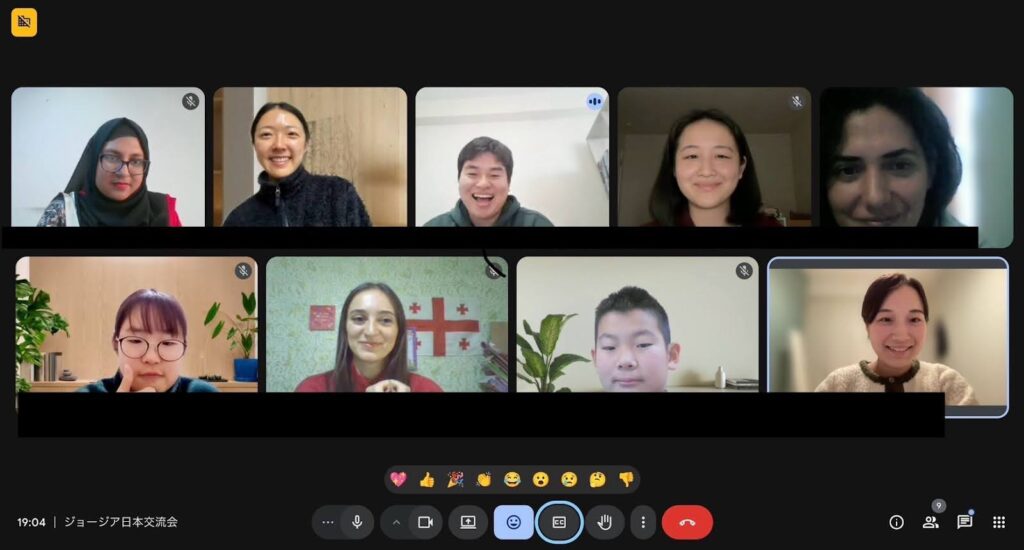
The session on the theme of “education”
It was a very precious and rich time, bringing together participants involved in “education” from a wide range of positions, elementary school, high school and university students, a school counselor, teachers, someone in out-of-school education and an HR specialist, who could each talk about the situation as they see it.
Our hopes for “Soreiyu (provisional name)”
These exchange sessions have grown beyond a place for simply introducing cultures into a place where we can learn about and talk about “the reality somewhere in the world.” They have become a time to realize that what is “normal” for us is not normal everywhere, and to learn from our differences.
Members who joined with a vague feeling of “this looks fun” are now, across languages and cultures, coming to see events in the world not as distant matters that don’t concern them, but as issues their friends are facing.
We have run these sessions hoping they can become a place where people can share their feelings safely and think together.
A year has passed since we started, and the connections born in the sessions are creating new connections. I see great meaning in this circle that is gradually widening.
There is something I feel especially strongly through my work as a JICA Overseas Cooperation Volunteer: the information on the internet picks up and spreads only a small part of people’s voices.
It is not unusual for what the media report and what local people say to differ. There are many-sided realities that only become visible once you live and work alongside people on the ground.
I think most of the world events we hear about in daily news feel unrelated to our own lives. In reality, it may be difficult to understand everything as “my own issue.”
That is exactly why I think it is important to increase the number of things that become “a friend’s issue” through the people we meet.
When there is someone you have actually met face to face, your interest in and respect for others become more concrete.
What matters is being able to picture not an “event” happening in the world, but the “faces of the people” facing it.
I believe that actions taken with someone in mind are what have the power to move the world.
And from here
Building on our bond with Forum2050 members, we want to develop this into a place where anyone can connect with people all over the world. JICA Overseas Cooperation Volunteers work not only in Georgia but all over the world, in Asia, Africa, Latin America, Oceania, the Middle East and Europe. This exchange session has the potential to turn the relationships our fellow volunteers have built locally into a network that crosses borders.
Through the space for exchange we are creating with Forum2050, I want to expand opportunities for young people around the world, including Japan, to meet, talk and think about the future together.
Anyone who is interested is very welcome.
The door to the world is open, so please feel free to come and join us.
Your interest is building a better world. We look forward to your participation!!
Inquiries and Consultations | Newsletter Registration
Forum2050 operates under the concept of ‘Children of the World: Each Child’s Vision for the Future Shapes Humanity’s Destiny,’ collaborating with businesses, schools, educational institutions, and others. Together with children, we create opportunities for them to contemplate peace and development in the future human society, fostering partnerships.